
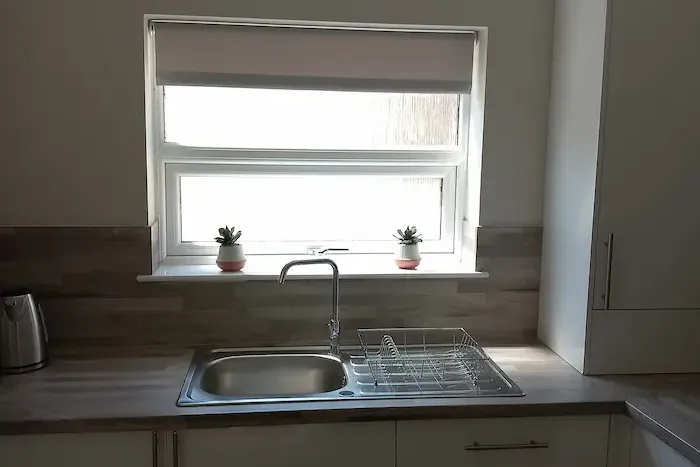
Kitchens are one of the trickiest rooms to choose blinds for. Steam from cooking, condensation from boiling water, grease splashes near the hob, and water splashes around the sink all create an environment that most blind fabrics are not designed to handle. Choose the wrong blind and you will be replacing it within a year or two.
This guide covers which blind types work best in kitchens, what fabrics to avoid, how to handle the window above the sink, and what to do about kitchen windows that are hard to reach or awkward to fit.
The Quick Answer: What Are the Best Blinds for Kitchens?
Roller blinds in moisture-resistant fabric are the best all-round choice for most kitchens. They are affordable, practical, easy to clean, and available in a wide range of colours. The PVC-coated fabric resists steam, condensation, and grease, and wipes clean with a damp cloth.
If you want adjustable light control, faux wood venetian blinds are the next best option. Faux wood will not warp in humidity the way real wood does, and each slat wipes clean individually. They cost more than roller blinds but give you the ability to angle light precisely.
For uPVC kitchen windows, perfect fit blinds are worth considering. They clip into the window frame with no drilling, sit close to the glass, and do not interfere with window handles or tilt mechanisms.
Avoid fabric roman blinds and real wood venetians in kitchens. Fabric absorbs steam and cooking odours over time, and real wood warps in humid environments. Both are better suited to living rooms and bedrooms.
Kitchen Blind Types Compared
Here is how the main blind types stack up for kitchen use:
| Blind Type | Kitchen Suitability | Moisture Resistance | Easy to Clean | Light Control | Price |
|---|---|---|---|---|---|
| Roller (moisture-resistant) | Excellent | Yes | Wipe clean | Full up/down | Most affordable |
| Faux wood venetian | Very good | Yes | Wipe each slat | Adjustable tilt | Mid-range |
| Aluminium venetian | Good | Yes | Wipe each slat | Adjustable tilt | Affordable |
| Perfect fit roller/pleated | Excellent | Yes (with right fabric) | Wipe clean | Full up/down | Slightly above standard |
| Roman blinds | Poor | No | Difficult | Full up/down | Higher |
| Real wood venetian | Poor | No (warps) | Dust only | Adjustable tilt | Premium |
| Curtains | Poor | No | Machine wash | Open/closed only | Varies |
Moisture-Resistant Roller Blinds: The Kitchen Standard
Moisture-resistant roller blinds are the most popular kitchen blind we fit, and for good reason.
How They Handle Kitchen Conditions
Standard roller blind fabrics are woven textiles that absorb moisture, grease, and odours over time. Kitchen-specific roller blinds use a PVC-coated fabric instead. The coating creates a non-porous surface that steam, condensation, and splashes sit on top of rather than soaking into. You wipe them clean the same way you would wipe a kitchen worktop.
The fabric does not discolour from cooking fumes, does not develop mould from condensation, and does not absorb the smell of last night’s dinner. After a year of daily kitchen use, a moisture-resistant roller blind looks the same as the day it was fitted.
Best Positions for Kitchen Roller Blinds
Above the sink. This is the most demanding position in any kitchen. The window directly above the sink gets splashed with water, hit with steam from the hot tap and dishwasher, and often has condensation forming on the glass. A moisture-resistant roller blind handles all of this. Mount it high enough that it clears the tap when lowered, and you can wipe it down when you clean the kitchen.
Near the hob. Windows near the hob are exposed to cooking steam and airborne grease. Moisture-resistant fabric is essential here. Keep the blind raised while cooking if the window is directly above or beside the hob, and lower it once the kitchen has aired.
Kitchen-diners. In open-plan kitchen-diners, you might want a different blind type in the dining area (roman blinds or curtains for warmth) and roller blinds on the kitchen side. We fit both and can coordinate the colours across different blind types.
Fabric Options for Kitchen Roller Blinds
- Translucent moisture-resistant: Lets in soft, diffused light while blocking the view from outside. Good for ground-floor kitchens facing a street or neighbouring property.
- Blackout moisture-resistant: Blocks light completely. Rarely needed in kitchens but useful for kitchen windows facing east where morning sun creates glare.
- Plain colours: White, cream, and light grey are the most popular kitchen choices because they keep the space feeling open and clean.
- Patterned: Available in moisture-resistant fabric too. Geometric patterns and botanical prints are popular for adding personality to a kitchen without committing to bold wall colour.
Faux Wood Venetian Blinds in Kitchens
Faux wood venetian blinds are the second most popular kitchen choice we fit. They look like real wood but are made from PVC or composite material that handles moisture without warping.
Why Faux Wood Works in Kitchens
The main advantage over roller blinds is adjustable light control. You can tilt the slats to any angle, directing light where you want it and blocking it where you do not. This is particularly useful in kitchens where you cook at different times of day and the sun hits the window from different angles.
Faux wood slats wipe clean individually with a damp cloth. Grease and steam do not penetrate the PVC surface. The slats will not discolour, warp, crack, or absorb odours regardless of how much cooking happens in the room.
When to Choose Faux Wood Over Roller
Choose faux wood venetian blinds for your kitchen if:
- You want to adjust light levels throughout the day without raising or lowering the blind
- You prefer the natural look of wood slats over fabric
- Your kitchen window faces a direction where glare changes significantly during the day
- You want the blind to look the same as venetian blinds in other rooms of the house
Choose roller blinds if:
- Budget is a priority (rollers cost less)
- You prefer a cleaner, more minimal look
- The window is directly above the sink and gets heavy splashing
Real Wood: Why Not in Kitchens
Real wood venetian blinds are beautiful in living rooms and bedrooms but they do not belong in kitchens. Wood is hygroscopic, meaning it absorbs and releases moisture as the humidity in the room changes. In a kitchen where humidity spikes every time you boil water or run the dishwasher, the slats expand and contract repeatedly. Over months, this causes warping, splitting, and discolouration that cannot be repaired.
If you love the look of wood venetians, use faux wood in the kitchen and real wood in the rest of the house. From a normal viewing distance, most people cannot tell the difference.
Perfect Fit Blinds for Kitchen Windows
Perfect fit blinds are designed for uPVC windows and doors. They clip into the window bead with no drilling, sitting within the glass unit rather than over the frame.
Why They Work Well in Kitchens
Many modern Edinburgh kitchens have uPVC windows, especially in newer builds and renovated properties. Perfect fit blinds are ideal here because:
- No drilling near worktops. Drilling brackets above a kitchen sink or worktop risks damaging tiles or splashbacks. Perfect fit eliminates this entirely.
- No dangling cords. The blind operates without cords or chains, which is safer and cleaner in a food preparation area.
- The blind moves with the window. If you tilt or open the window for ventilation while cooking, the blind stays in position.
- Close fit to the glass. Because the blind sits within the window bead, there is less space for grease and dust to accumulate between the blind and the glass.
Perfect fit is available as roller, pleated, or venetian. For kitchens, perfect fit roller with moisture-resistant fabric is the most popular combination.
Kitchen Windows in Older Edinburgh Properties
Edinburgh’s older kitchens present specific challenges that newer homes do not have.
Sash Windows in Kitchens
Many Edinburgh tenement kitchens have original sash windows. These are not uPVC, so perfect fit is not an option. The best approach is a moisture-resistant roller blind fitted inside the window recess. We measure the recess precisely to account for the sash frame profile and any unevenness (common in older properties where the frames have settled over decades).
The deep recesses typical of Edinburgh sash windows actually work in your favour for kitchen blinds. The blind sits well back from the worktop and sink, reducing direct splash exposure while still covering the glass.
Small Kitchen Windows
Older Edinburgh kitchens often have smaller windows than modern ones. A single roller blind is usually the simplest and most cost-effective solution. The slim profile of a roller blind does not crowd a small window the way a venetian or roman blind might. Choose a light-coloured, translucent fabric to maximise the natural light coming through.
Galley Kitchens
Narrow galley kitchens, common in Edinburgh tenements, often have one window at the end. This window is usually the kitchen’s only source of natural light, so blocking it completely is not ideal. A translucent moisture-resistant roller blind lets light through while providing privacy. Alternatively, a faux wood venetian lets you tilt the slats to direct light along the galley without glare.
How to Clean Kitchen Blinds
Even moisture-resistant blinds need regular cleaning in a kitchen environment. Here is what works for each type:
Moisture-resistant roller blinds: Wipe down with a damp cloth and mild washing-up liquid. For stubborn grease spots, a kitchen degreaser spray works well. Do not submerge the fabric or use abrasive cleaners. Clean every 2 to 4 weeks depending on how much cooking happens.
Faux wood venetian blinds: Close the slats flat and wipe along each one with a damp cloth. Flip the slats and repeat on the other side. For grease build-up, use a mild soapy solution. Dry with a soft cloth to avoid water marks. Clean monthly.
Aluminium venetian blinds: Same as faux wood but they can tolerate slightly more aggressive cleaning. A damp microfibre cloth works well. These are the easiest kitchen blind to keep clean.
Perfect fit blinds: Unclip the blind from the window, lay it flat, and wipe down. Reclip when dry. The ability to remove the blind easily makes deep cleaning straightforward.
Frequently Asked Questions
Can you put roller blinds above a kitchen sink?
Yes, and it is the most common position we fit them. Use a moisture-resistant roller blind and mount it high enough to clear the taps when lowered. The PVC-coated fabric handles water splashes, steam, and condensation without any problems.
Are roman blinds OK for kitchens?
We do not recommend fabric roman blinds for kitchens. The fabric absorbs steam, cooking odours, and airborne grease over time. Cleaning a roman blind is difficult because you cannot wipe it down like a roller or venetian. Stick to roller blinds or faux wood venetians for kitchen windows.
What colour blinds are best for kitchens?
White, cream, and light grey are the most popular because they keep the kitchen feeling bright and clean. Lighter colours also show less dust and water marks than darker ones. If you want to add colour, consider a patterned moisture-resistant roller blind rather than a bold solid colour, as patterns hide marks better.
How often should you replace kitchen blinds?
A quality moisture-resistant roller blind should last 5 to 10 years in a kitchen with regular cleaning. Faux wood venetians last even longer because the PVC slats are extremely durable. Cheap off-the-shelf blinds in non-resistant fabrics may need replacing within 1 to 2 years due to moisture damage and discolouration.
Can perfect fit blinds go in any kitchen?
Only if your kitchen windows have uPVC frames. Perfect fit blinds clip into the uPVC window bead. They do not work on wooden frames, aluminium frames, or traditional sash windows. We check compatibility during your free home visit.
Get the Right Kitchen Blinds
The best blinds for your kitchen depend on your window type, your cooking habits, and how much natural light you want to let in. Moisture-resistant roller blinds are the safe, affordable choice that works for most kitchens. Faux wood venetians give you more light control at a higher price point. Perfect fit is ideal if you have uPVC windows and want a no-drill solution.
The easiest way to decide is to see the options in person. Get in touch and we will bring samples to your kitchen, measure your windows, and recommend the best option for your specific setup. Free, no-obligation, and no hard sell. Everything is made by hand at our Edinburgh blinds workshop in Leith.
Call us on 0131 553 1073 or fill in the contact form.