
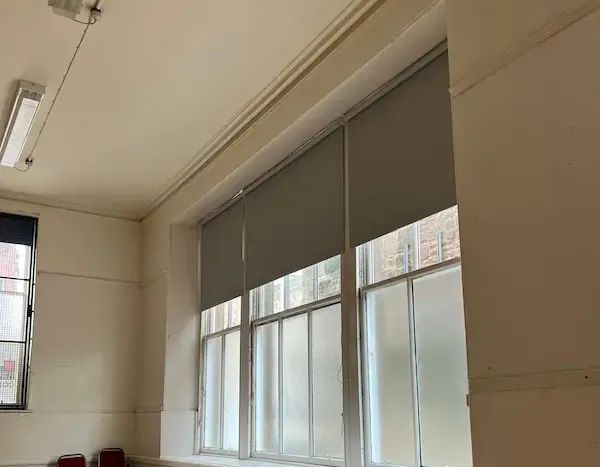
Choosing blinds for an office is different from choosing them for your home. The priorities shift. Glare on computer screens becomes the main concern. Fire safety regulations apply. Durability matters more because the blinds get used by multiple people every day. And the installation needs to happen with minimal disruption to your business.
This guide covers the main types of office blinds, what to consider for different commercial spaces, fire safety requirements, motorised options, and how to manage the installation process without losing productive working days.
The Main Types of Office Blinds
Aluminium Venetian Blinds
The most common choice for offices. Slim 25mm aluminium slats that tilt to any angle, giving precise control over glare and light levels. When a monitor faces a window, being able to angle the slats to redirect sunlight away from the screen without closing the blind completely makes a real difference to comfort and productivity.
Aluminium venetian blinds are lightweight, durable, fire-retardant as standard, and available in a wide range of colours and metallic finishes. Perforated slats are available for offices where maximum glare reduction is needed while maintaining a view out. They are also the easiest office blind to clean, with each slat wiping down in seconds.
Best for: Open-plan offices, individual offices with computer workstations, meeting rooms with screens or projectors.
Commercial Roller Blinds
Roller blinds in commercial-grade fabrics offer a clean, uniform look across a whole floor. They are available in blackout for presentation rooms, translucent for areas where you want diffused light, and screen fabrics that reduce glare while maintaining visibility.
Commercial roller blinds use heavy-duty mechanisms rated for frequent daily operation. Cassette-mounted systems protect the fabric when raised and give a neater appearance than open rollers. For offices with large numbers of windows, roller blinds are often the most cost-effective option because they are faster to manufacture and install than venetians.
Best for: Large open-plan offices, conference rooms, reception areas, co-working spaces.
Vertical Blinds
Vertical fabric louvres that rotate for light control and draw to one side. Vertical blinds were the default office choice for decades, and while they have fallen out of fashion in favour of venetians and rollers, they remain a practical and cost-effective option for commercial spaces with standard windows.
They are particularly useful for wide windows where a horizontal blind would be too heavy to operate smoothly. Fire-retardant fabrics are standard, and the louvres are individually replaceable if one gets damaged, which reduces long-term maintenance costs.
Best for: Budget-conscious installations, wide windows, spaces where individual louvre replacement is an advantage.
Motorised Blinds
Motorised blinds eliminate the need for manual operation, which matters in offices with hard-to-reach windows, floor-to-ceiling glass, or large numbers of blinds that would be impractical to adjust individually.
They can be controlled by remote, wall switch, timer, or integrated into a building management system (BMS). Timer-based control means the blinds adjust automatically throughout the day as the sun moves, reducing glare without anyone needing to think about it. This is increasingly popular in modern Edinburgh office fit-outs.
Motorisation is available on both roller and venetian blinds. The motors are quiet and the power supply is typically hardwired during the fit-out, though battery-powered options exist for retrofit installations.
Best for: New-build offices, floor-to-ceiling glass, buildings with BMS integration, any space where manual operation is impractical.
What to Consider When Choosing Office Blinds
Glare Control
Glare is the number one reason offices need blinds. Uncontrolled sunlight on screens causes eye strain, headaches, and reduced productivity. The Health and Safety Executive’s guidance on display screen equipment (DSE) specifically requires employers to control glare and reflections on screens.
Venetian blinds give the most granular glare control because you can angle the slats precisely. Screen fabrics on roller blinds reduce glare while maintaining an outward view, which is a good compromise for offices that want to keep a connection with the outside. Blackout roller blinds are the right choice for rooms with projectors or screens where any ambient light is a problem.
Fire Safety
UK building regulations require fire-retardant window coverings in most commercial premises. The relevant standard is BS 5867, which covers the flammability of curtains and drapes used in contract situations (offices, schools, healthcare, hospitality, and public buildings).
All our commercial blinds are available in fabrics that meet BS 5867. This is not optional for most offices, and it is your responsibility as the building owner or tenant to ensure compliance. We advise on the specific requirements during the site survey and only supply fabrics that meet the necessary standards.
Durability
Office blinds get more use than residential blinds. They are raised and lowered multiple times a day, often by different people who may not be gentle with them. Commercial-grade mechanisms are designed for this level of use. The mechanisms in domestic blinds are not, and will fail significantly faster in a commercial environment.
When we quote for office blinds, we specify commercial-grade components as standard. The price difference over domestic-grade is small, but the lifespan difference is significant.
Privacy
Ground-floor offices, meeting rooms, and reception areas often need privacy from the street or from other parts of the building. Translucent roller blinds provide daytime privacy while letting in light. Venetian blinds can be angled to block the line of sight from specific directions. Blackout roller blinds provide complete visual privacy when needed for sensitive meetings or presentations.
Noise and Acoustics
In open-plan offices, fabric blinds can contribute to acoustic management. Heavy roller blind fabrics and vertical blind louvres absorb some sound, reducing the hard reflections that make open offices noisy. This is a secondary benefit rather than a primary solution, but it is worth considering when specifying fabrics for large installations.
Office Blinds for Different Spaces
Open-Plan Offices
The challenge with open-plan is consistency. You need every window to look the same while giving individuals some control over their immediate environment. Aluminium venetian blinds or roller blinds in a single colour across all windows create a uniform appearance. Venetians are better if different areas face different directions, because each blind can be tilted independently.
Meeting Rooms and Boardrooms
Blackout or near-blackout capability is important for rooms with screens and projectors. A roller blind with blackout fabric and a cassette system delivers near-total darkness when lowered. For meeting rooms with glass partitions facing the main office, a translucent roller or perfect fit blind provides privacy without blocking all light.
Reception and Client-Facing Areas
Appearance matters more here than in the back office. Consider higher-quality finishes: faux wood venetians for a warmer look, or roller blinds in a fabric that complements your brand colours. If the reception faces a busy street, a screen fabric roller blind reduces glare and UV while keeping the space feeling open and connected.
Co-Working and Shared Spaces
Durability and ease of maintenance are the priorities. Aluminium venetians are the most robust option and the easiest to clean. Avoid fabrics that stain or mark easily. Motorised blinds are worth considering if the space is used by many different people, as they eliminate the wear from constant manual operation.
Server Rooms and IT Spaces
Blackout is essential to control temperature and protect equipment from direct sunlight. A simple blackout roller blind is sufficient. Ensure the fabric is fire-retardant and the mechanism is rated for the temperature range in the room.
Managing the Installation
Office blind installations need to be planned around your business operations. Here is how we handle it:
Site survey. We visit your premises, assess the windows, discuss your requirements, and advise on the best blind types and fabrics. For multi-floor buildings, we survey the entire scope before quoting so you get one comprehensive price.
Scheduling. We can install during business hours, but many Edinburgh businesses prefer early morning, evening, or weekend installations to avoid disruption. We are flexible and will work around your schedule. For larger projects, we phase the installation floor by floor or zone by zone.
Speed. A small office with 10 to 15 windows can typically be completed in a single day. A full floor of 50 to 80 windows takes 2 to 3 days depending on the blind type. We provide a clear timeline during the quoting stage.
Clean-up. We remove all packaging, dispose of old blinds if requested, and leave the space ready to use. No mess, no loose fixings, no follow-up visits needed.
What It Costs
Office blind pricing depends on the number of windows, the blind type, the fabric specification, and whether motorisation is required. We provide free site surveys and detailed, itemised quotes for all commercial projects.
Because we manufacture in our Leith workshop rather than ordering from a factory, we can offer competitive pricing without the middleman markup. Volume discounts are available for larger installations.
Every quote includes the blinds, commercial-grade mechanisms, the bracket system, professional installation, and a 3-year guarantee. No hidden costs.
Ready to Get Started?
If you need office blinds in Edinburgh, get in touch for a free site survey. We will assess your windows, advise on the best options, and provide a clear, itemised quote. We cover Edinburgh, Glasgow, Fife, and central Scotland. As a full-service Edinburgh blinds and curtains workshop, we manufacture everything in Leith and stand behind it with a 3-year guarantee.
Call us on 0131 553 1073 or fill in the contact form.